
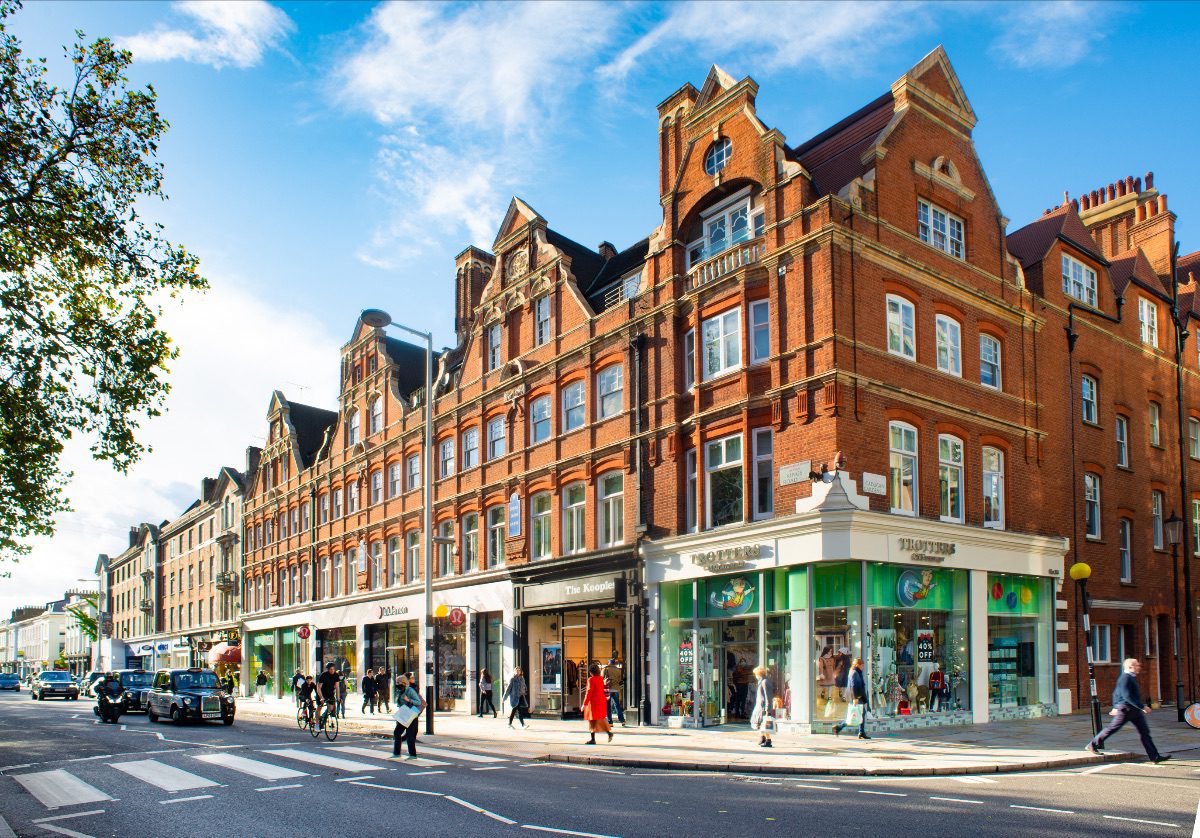
Once a private passage reserved for monarchs, King’s Road has transformed into one of London’s most influential cultural locations. The street maps a fascinating timeline of fashion, politics and social change in the Royal Borough of Kensington and Chelsea.
Road for a King
Long before it became synonymous with fashion and nightlife, King’s Road existed as a discreet route for royal travel. Established in the late 17th century during the reign of Charles II, the road was created as a private passage connecting St James’s Palace to the rural village of Chelsea.
The road allowed the monarch to travel quickly between central London and the countryside residence at Chelsea Royal Hospital, which Charles II founded in 1682. For over a century, access to the road was restricted. Only royalty and those granted explicit permission could pass along it, reinforcing status as an exclusive passing of power and privilege.
However, by the early 1800s, the road gradually opened to the public. As London expanded, Chelsea evolved from a riverside village into a thriving suburb. Elegant townhouses and artistic communities began to flourish along the route, laying the foundations for the creative spirit that would later define the street.
The bohemian century
Throughout the 19th century, Chelsea become synonymous with artistic and intellectual buzz. Writers, painters and designers gravitated toward the neighbourhood, drawn by its slightly rebellious spirit, distant from the tighter conventions that ruled central London society.
King’s Road became a social hub for the creative minds of London. Nearby studios and homes situated figures contributing to the Pre-Raphaelite Brotherhood art movement, including the infamous founder, Dante Gabriel Rossetti. Their presence helped cement Chelsea’s reputation as a place where art and culture could flourish beyond the confides of traditionalism.
By the early 20th century, the street had become animated with cafés, small boutiques and cultural meeting points. Yet its spirited transformation was only just beginning.
The fashion revolution
The 1960s marked a defining chapter in King’s Road’s history. As London emerged as the hive of youth culture, music and fashion, the street became an exciting laboratory for experimentation.
Designer Mary Quant profoundly shaped this ear with her boutique, Bazaar, opening in 1955 when she was just 21 years old. Quant’s designs helped popularise the miniskirt, a garment that introduced a playful aesthetic and a type of cultural optimism that went on to inspire the decade.
King’s Road quickly evolved into a destination for fashion-forward Londoners. Boutiques and record stores lined the street, attracting musicians, artists and models, all contributing to the city’s ever-growing identity.
At the same time, the neighbourhood’s nightlife flourished. Clubs and restaurants became meeting points for the creative elite, cementing King’s Road as one of the most vibrant places in London during the era known as ‘Swinging London’.
The 1970s brought rebellion. The road once again found itself at the centre of a conformational new movement. Fashion designers Vivienne Westwood and Malcom McLaren opened a boutique at 430 King’s Road that would eventually become the legendary shop, SEX.
The store became a symbol of the emerging punk movement. Its provocative designs, political slogans and confrontational aesthetics challenged traditional fashion norms and attracted a generation eager to reject mainstream culture. Big-name visitors such as members of the Sex Pistols helped transform punk into a global phenomenon.
Contemporary luxury
By the 1980s and 1990s, King’s Road began transitioning to a refined retail destination. Independent boutiques gradually gave way to designer stores and lifestyle brands.
Today, the street reflects the broader identity of the Royal Borough of Kensington and Chelsea- elegant and historic yet constantly evolving. High-end retailers sit alongside heritage institutions, maintaining the road’s longstanding connection to style and culture. Few streets on London have shaped cultural identity so consistently across centuries.
Timeline: the evolution of King’s Road
| Period | Key moment |
| 1690s | King’s Road built as a private route for King Charles II |
| 1830 | Road gradually opens for public use |
| Late 1800s | Chelsea becomes a hub for writers and artists |
| 1960s | King’s Road becomes a hub for Swinging London fashion |
| 1970s | Punk rise inspired by Vivienne Westwood and Malcom Mclaren |
| 1980s-2000s | The street transitions toward luxury retail |
| Today | A blend of heritage fashion, dining and cultural landmarks |
King’s Road’s appeal lies in its ability to adapt without losing its identity. Across more than three centuries, it has evolved from royal passage to artistic territory.
By Anna Bodiam