
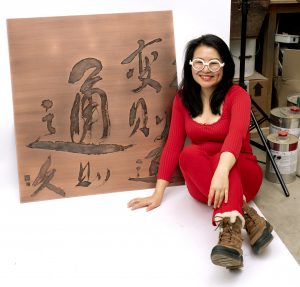
Yap Pau Ling is a London-based, award-winning multidisciplinary artist whose work bridges Eastern traditions with Western sensibilities, disciplines, and materials. Pau Ling is of Malaysian Chinese heritage and her practice is rooted in storytelling—expressed through an expansive visual language that spans Chinese ink painting, calligraphy, oil, charcoal, pencil, watercolour, metalwork, and installation. Alongside her artistic career, Pau Ling is also an actuary—a rare duality that underpins her distinctive approach. Her work balances analytical rigour with intuitive exploration, examining materials, relationships, and the structures that shape human experience.
Her artistic journey began early. She trained in Chinese ink painting and calligraphy from the age of ten and held her first solo exhibition at just thirteen. She later studied architecture, completing her Royal Institute of British Architects (RIBA) Part 2, an education that continues to inform her spatial awareness, material experimentation, and approach to installation design. Pau Ling’s work has received widespread recognition. She is the recipient of the Din Tai Fung Art Competition (2025), the AON Prize (2017), and the Liberty’s People’s Choice Awards (2021, 2024) at the Lloyd’s Art Group Winter Exhibitions. She has also been listed for the Jackson’s Art Prize. Her work addressing workplace bullying was published in Haus-A-Rest, and her Pandemic Portrait series—capturing the emotional realities of lockdown, including a triple portrait of Bank of England Governor Andrew Bailey—is held in the Bank of England Museum.
Her work has been exhibited nationally and internationally, and is held in both private and corporate collections, including Sompo and the Bank of England Museum. Extending her practice beyond exhibitions and collections, she undertakes commissions and leads workshops and corporate events for organisations such as the Bank of England, AXA XL, Aspen, the City of London Club, and Hilton Hotel.
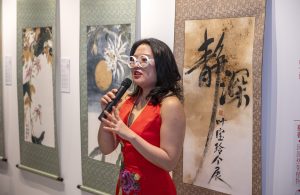
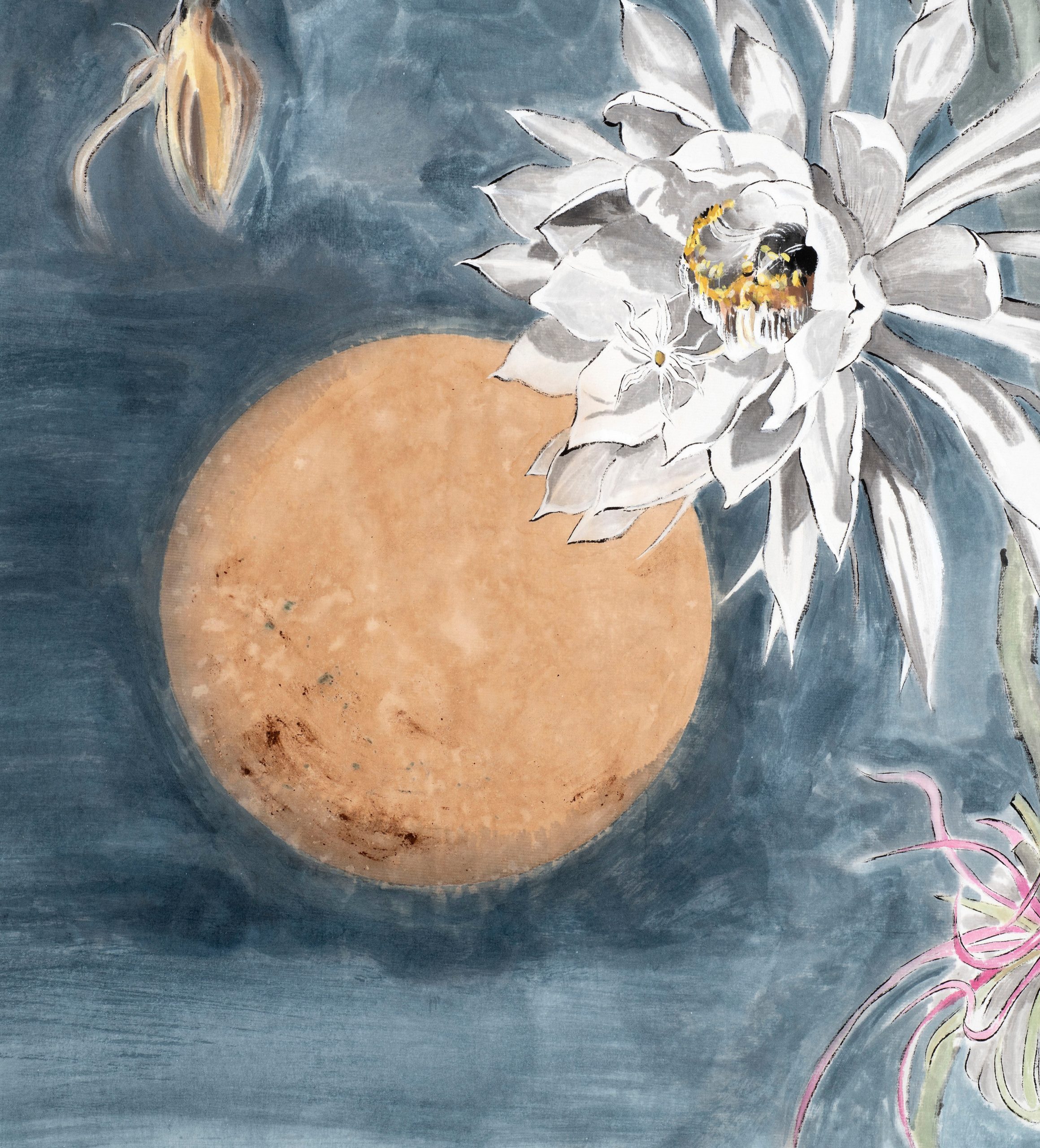
At the core of Pau Ling’s practice lies a restless curiosity, and it is through art that her curiosity finds its most compelling and resonant expression. Her latest works continue to push boundaries in materiality, from painting with coffee on rice paper to translating calligraphy into laser-engraved metal. KCR readers will be thrilled to know that her latest solo exhibition, Still Depth – Whispers of the Wild, currently on display until 13 June 2026 at Khaw Gallery, Dāku Kensington, offers a particularly vivid example. The series is a meditation on tropical plant fragility and impermanence, and the quiet resilience of nature.
The exhibition title itself carries a dual meaning. “Still” evokes the delicate equilibrium of the natural world, while “Depth” refers both to the tonal richness of Dāku coffee and the layered density of tropical ecosystems. Together, they frame a body of work that is as conceptually rich as it is visually subtle.
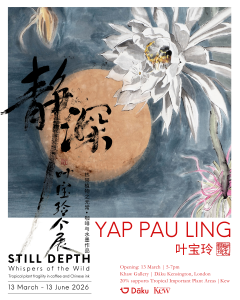
The series comprises eight unique works depicting tropical plant species from Brazil, Colombia, Costa Rica and Mexico. Each piece is created using brewed Dāku coffee sourced from the plant’s country of origin, combined with traditional Chinese ink techniques on rice paper and mounted as silk scrolls. Painting with coffee is technically ambitious and involved extensive experimentation with binders to stabilise coffee whilst enabling its full range of tonal and textural expression.
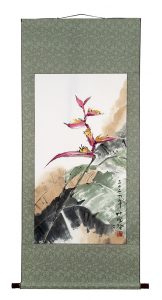
In support of tropical plant conservation, 20% of proceeds from the exhibition will be donated to the Tropical Important Plant Areas (TIPAs) programme at the Royal Botanic Gardens, Kew. The programme works to protect vulnerable plant species in some of the world’s most at-risk regions – a mission that closely aligns with the themes explored in this exhibition.
Fans of her work can also look forward to Traces of Humanity, showing in Margate (1 May – 28 May 2026), where Pau Ling will be giving a talk on 9 May, and Gibraltar (30 June – 31 July 2026). Traces of Humanity is a group exhibition inspired by the Gorham’s Cave Complex in Gibraltar, a UNESCO World Heritage Site.
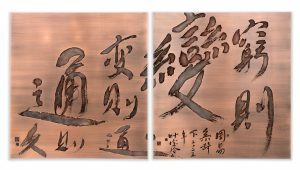
Her contribution, Continuum (Fragment I) and Continuum (Fragment II), examines the interplay between humanity’s lineage of knowledge—preserved and transmitted through language—and forces of innovation that propel it forward.
Anchored in Chinese calligraphy, whose origins trace back to ancient bone script, the work is deeply rooted in the artist’s cultural heritage. It draws on the philosophy of the Yi Jing (c. 1000 BC): “Stagnation sparks change; change brings continuity”, highlighting enduring wisdom across millennia. The script morphs from traditional script in Fragment I “Stagnation sparks change”, to simplified script in Fragment II, “Change brings continuity”, aligning philosophical progression with linguistic evolution, thus visually embodying both lineage and evolution.
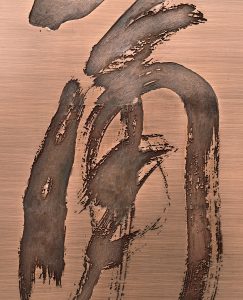
The making process itself reflects this dialogue between past and present. Calligraphy is first handwritten with ink and brush on rice paper, then translated into laser-engraving on aluminium – an act that bridges tradition and modern technology. The surface is subsequently finished with hand engraving, reintroducing the artist’s gesture and echoing the tactile immediacy of Gorham’s prehistoric cave scratchings. A final layer of copper-plating invokes humanity’s first metal, reinforcing the work’s temporal depth. The result is a layered work that fuses tradition with technology, echoing both ancient cave marking and contemporary industrial process.
Presented as a diptych, the two halves resemble archaeological fragments – partial yet resonant, each holding traces of a larger whole. Their reflective surfaces draw the viewers into the work, positioning them not as observers, but as participants within this unfolding continuum of human history.
https://www.pauling.london/still-depth